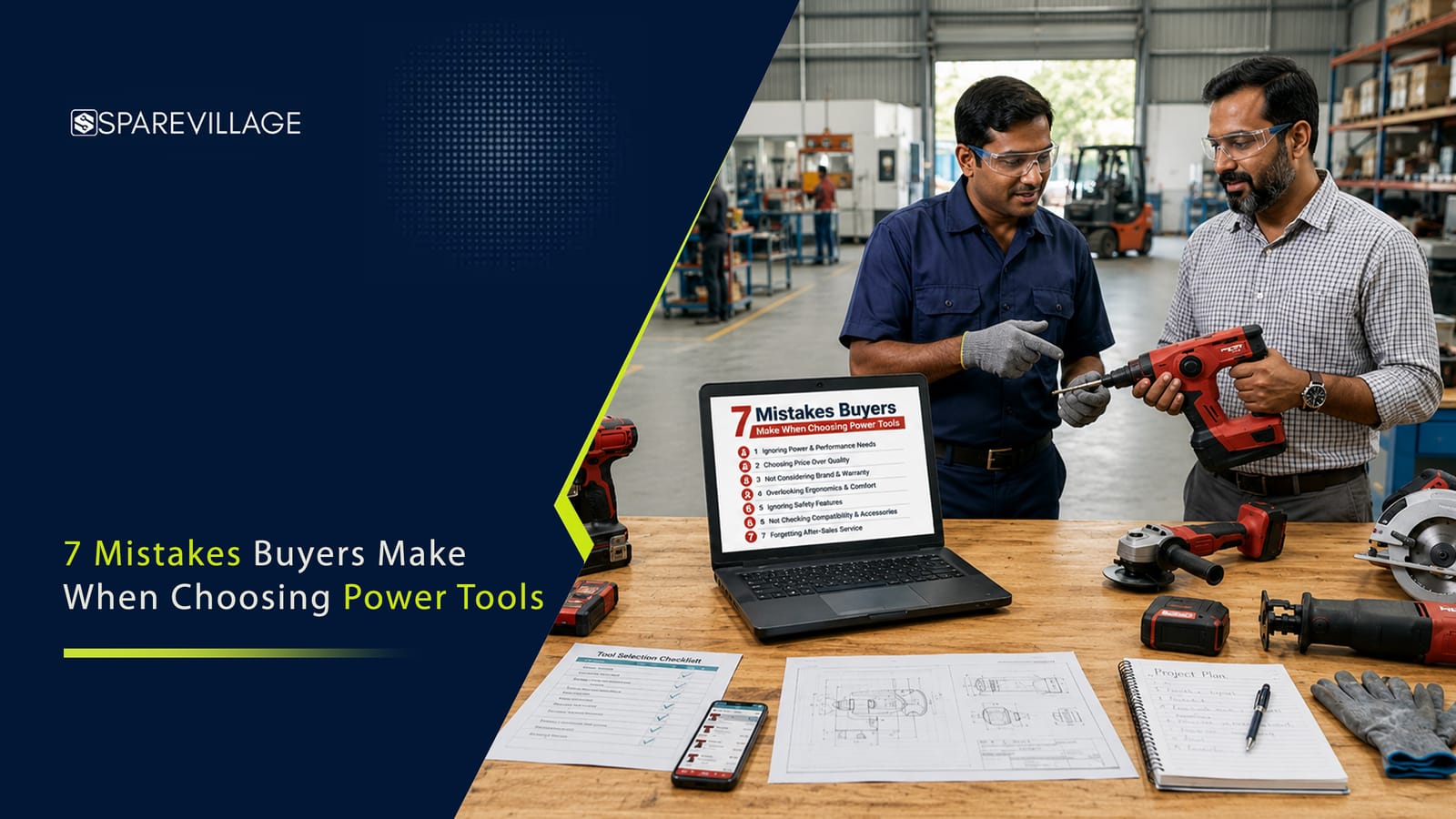
7 Mistakes Buyers Make When Choosing Power Tools | Sparevillage
7 power tools buying mistakes industrial buyers make. Avoid costly errors and shop verified power tools on the Sparevillage marketplace.
Article Content
Intro:
Every industrial buyer has a story about a power tool that let them down at the wrong moment. A drill that stopped mid-shift. A grinder that burned out in three months. A "branded" tool that turned out to be a copy.
These are not bad luck stories. They are buying mistakes. And they repeat across factories, workshops, and procurement desks all over India.
If you are a factory owner, a workshop manager, or a founder scaling your own manufacturing unit, the power tools you choose directly affect your output, your downtime, and your budget. One wrong purchase does not just cost money. It costs production hours you can never get back.
This article breaks down the seven mistakes buyers make when choosing power tools, why each one happens, and what you should do instead. No filler. No generic tips you have already read a hundred times. Just the real problems buyers face and direct, practical answers.
By the end, you will know exactly what to check before you place your next order, and where to find power tools that are verified, tested, and built for industrial use.
Mistake 1: Choosing Power Tools Based on Price Alone
This is the mistake almost every buyer makes at least once.
A vendor quotes a price 20% lower than the market rate. It feels like a win. You place the order. Three months later, the motor is weak, the chuck is loose, and the tool cannot survive a full shift.
Cheap power tools are rarely cheap in the long run. Lower-cost units often use thinner copper windings, weaker bearings, and plastic components in places that should be metal. They fail faster under continuous industrial load, and each failure means a replacement order, a delayed job, and an unhappy client on your end.
The right question is not "what is the lowest price?" It is "what is the lowest total cost over the tool's working life?" A tool priced 15% higher but lasting three times longer is the cheaper option every single time.
Price still matters. Nobody is asking you to overspend. But price should be one factor among many, not the only one. Compare specifications, ampere rating, duty cycle, and brand reliability side by side before you decide.
This is exactly why buyers are moving toward platforms that show transparent pricing and verified specifications upfront, instead of negotiating blind with a single local vendor.
Mistake 2: Buying a Tool That Does Not Match the Job
A cordless drill that struggles with concrete. A circular saw too heavy for plywood. A grinder with the wrong RPM for the material you cut daily.
This mismatch happens more often than buyers admit. It usually comes from buying a "general purpose" tool without checking if it fits your specific, repeated use case.
Industrial work is not occasional home use. Your tools run for hours, sometimes across multiple shifts. A tool built for light-duty tasks will overheat, slow down, or fail early when pushed into heavy industrial cycles.
Before buying, ask three simple questions:
What material will this tool work on most often?
How many hours a day will it run?
Does the power rating and RPM match that workload?
If you skip this step, you end up paying twice: once for the wrong tool, and again for the right one.
We covered this exact problem in detail in our blog on the Industrial Buyer's Guide to Professional Power Tools | Sparevillage, where we break down how to match tool specifications to actual shop-floor demands.
Mistake 3: Skipping Supplier Verification
Here is a problem most buyers never think about until it is too late: the seller you are buying from may not even be the manufacturer.
Many "suppliers" are actually trading companies reselling stock with no accountability if something goes wrong. No factory to verify. No consistent quality across batches. No real warranty backing.
This is a bigger risk for industrial buyers than most people realize. If a batch of tools fails, and your supplier cannot trace it back to a verified manufacturer, you have no real recourse. You are stuck.
Before placing a bulk order, verify:
Is the seller a registered, verified business?
Do they list GST and business documentation?
Can they show consistent stock history and buyer reviews?
This is the entire reason SpareVillage exists as a B2B marketplace. Every seller listed on the platform is verified before their products go live, so industrial buyers are not gambling on an unknown trading company. When you explore industrial tools and equipment on SpareVillage, you are dealing with sellers who have already been checked, not names picked off a random search result.
Mistake 4: Ignoring Spare Parts and Consumables Availability
A power tool is not a one-time purchase. It is an ongoing relationship with blades, discs, brushes, chucks, and batteries.
Buyers often fall in love with a tool's core performance and completely forget to check whether its consumables are easy to find later. Then, three months in, they cannot source a matching blade or a replacement battery, and the tool becomes dead weight in the storeroom.
This mistake compounds fast if you are running multiple units of the same tool. Inconsistent consumables across your tool lineup means more downtime, more returns, and more frustrated operators.
Before buying, check:
Are spare parts and consumables locally available?
Are they standardized, or does this brand use proprietary parts you cannot get elsewhere?
Does the seller stock replacement parts directly?
If you want a full breakdown of how professional workshops manage this exact issue, our blog on How to Maintain Power Tools Like a Professional Workshop covers the maintenance side in depth, and it connects directly to this buying mistake.
Mistake 5: Overlooking Warranty and After-Sales Support
A tool without a clear warranty is a risk you are choosing to take, whether you realize it or not.
Many buyers focus so heavily on upfront specifications that they never ask the simple question: what happens if this fails in month four?
Weak or vague warranty terms are a red flag. So is a seller who cannot clearly explain their return or replacement policy before you buy. Industrial tools work under real stress. Failures happen even with good brands. What separates a good purchase from a bad one is what happens next.
Look for:
A clearly stated warranty period, in writing
A defined process for replacement or repair
A seller who responds to after-sales queries, not just pre-sale ones
This single factor decides whether a tool failure costs you a day of downtime or a month of back-and-forth emails.
Mistake 6: Not Testing Before Placing a Bulk Order
If you are buying in volume, whether it is 10 units or 100, ordering blind is one of the costliest mistakes you can make.
A brochure can tell you the wattage. It cannot tell you how the tool feels after two hours of continuous use, whether it overheats, or whether the switch holds up after a thousand cycles.
A short pilot run, even with a single unit, tells you more than any spec sheet. Pay attention to:
Heat buildup during sustained use
Any unusual noise or vibration
Consistency of performance across repeated cycles
How the tool feels in the operator's hand after extended use
If a single unit fails during this pilot phase, that is valuable information. It tells you whether the issue is a one-off defect or a real design weakness across the entire batch.
This step alone prevents the single most expensive mistake on this list: a full bulk order of tools that were never right for your shop floor in the first place.
For a structured way to run through this before every purchase, our 12-Point Power Tools Buying Checklist for Professionals | Sparevillage walks through exactly what to verify before you commit to volume.
Mistake 7: Ignoring Safety Standards and Certification
This mistake does not just cost money. It puts people at risk.
Some buyers skip checking for basic safety features because the tool "does the job" on paper. No safety lock, no proper grip, no quick-stop mechanism after switch-off. These are not minor extras. They are the difference between a safe shift and a workplace injury.
Certification matters too. A tool without proper compliance documentation can create liability issues, especially in industrial settings where safety audits are routine.
Before buying, confirm:
Does the tool have a safety lock and soft-grip design?
Does it stop quickly and safely when switched off?
Does the seller provide compliance and certification documents?
Pairing the right power tools with proper safety and PPE gear is not optional in an industrial setting. It is the baseline. Cutting corners here is the one mistake that cannot be measured in rupees alone.
How to Avoid All Seven Mistakes at Once
If you read through this list and recognized a mistake you have made before, you are not alone. Almost every buyer has made at least two or three of these at some point. The real fix is not memorizing seven rules. It is buying from a source that already accounts for all of them.
This is where a verified B2B marketplace changes the equation. Instead of chasing individual vendors, verifying each one manually, and hoping the specifications match reality, you get:
Verified sellers, so supplier risk is handled before you even start browsing
Transparent specifications, so tool-to-job mismatch becomes far less likely
Consistent consumables and spare parts availability across listed sellers
Clear warranty terms visible upfront, not buried in a phone call
A wide catalog, so you can compare instead of guessing
SpareVillage was built around exactly this need. As a B2B marketplace for industrial buyers, it removes the guesswork that leads to most of the mistakes above. When you are ready, you can explore industrial tools and equipment on the platform and directly buy power tools from the marketplace, knowing the sellers behind them have already been checked.
If you want to go deeper into the buying process itself, our The Complete Buyer's Guide to Industrial Power Tools | Sparevillage and Essential Professional Power Tools List for Industrial Buyers | Sparevillage are two of our most detailed reads, and they pair naturally with everything covered here. You can also read Avoid These Mistakes When Buying Power Tools | Sparevillage for a closer look at how buyers can spot red flags before an order is placed.
Conclusion
Buying power tools for an industrial operation is not a small decision. It affects your output, your safety record, and your budget for months, sometimes years, after the purchase.
The seven mistakes covered here, chasing the lowest price, ignoring job-fit, skipping supplier verification, forgetting about consumables, overlooking warranty terms, skipping test runs, and cutting corners on safety, are the same mistakes that quietly drain time and money from workshops every single day.
None of them are complicated to avoid. They just require asking the right questions before you place an order, not after a tool fails on the shop floor.
If you want to skip the guesswork entirely, SpareVillage is built to help. As a trusted B2B marketplace, it connects industrial buyers with verified sellers, transparent specifications, and a catalog built for real shop-floor needs. Explore the platform, compare your options, and make your next power tool purchase one you do not have to think twice about.
FAQs:
1. What is the biggest mistake buyers make when choosing power tools?
The biggest mistake is choosing a tool based on price alone. A lower upfront cost often means weaker motors, thinner wiring, and shorter working life. This leads to early failure, repeat purchases, and production downtime. The smarter approach is comparing total cost over the tool's working life, not just the invoice amount.
2. How do I know if a power tool matches my industrial job?
Check the material you work with most, the daily running hours, and whether the power rating and RPM match that workload. A tool built for light use will overheat under continuous industrial cycles. Matching specifications to your actual job before buying prevents early breakdowns and repeated replacement costs.
3. Why does supplier verification matter when buying power tools in bulk?
Unverified suppliers may be trading companies, not manufacturers. If a batch fails, there is no accountability or traceability. Verifying business registration, documentation, and stock history before ordering protects you from receiving inconsistent quality across units, and ensures you have real recourse if something goes wrong after purchase.
4. What should I check about spare parts before buying a power tool?
Confirm whether blades, discs, batteries, and other consumables are locally available and standardized. Proprietary parts that are hard to source later cause downtime and force early tool replacement. Checking consumable availability before purchase, not after, keeps your tools running without unnecessary delays across your entire equipment lineup.
5. How important is warranty when buying industrial power tools?
Warranty is critical. It decides whether a tool failure costs a few hours or weeks of back-and-forth. Always confirm the warranty period in writing, along with a clear replacement or repair process. A vague or missing warranty is a direct sign of risk, regardless of how good the tool looks upfront.
6. Should I test power tools before placing a bulk order?
Yes, always. A brochure cannot show heat buildup, noise changes, or performance after hours of continuous use. A small pilot run before bulk ordering reveals real-world issues early. This single step prevents the costliest mistake on any buying list: ordering an entire batch of tools that were never right for the job.
7. What safety features should every industrial power tool have?
Every industrial power tool should have a safety lock, a soft, secure grip, and a mechanism that stops the tool quickly after switch-off. Skipping these features to save cost increases injury risk on the shop floor. Safety certification and compliance documents should also be confirmed before any purchase decision is made.
8. How does SpareVillage help buyers avoid power tool buying mistakes?
Sellers are verified before listing, specifications are shown transparently, and warranty terms are visible upfront. This removes the guesswork buyers usually face when dealing with unverified vendors, mismatched specifications, or unclear after-sales terms, making it easier to make a confident, informed purchase decision the first time.
9. Is SpareVillage a reliable B2B marketplace for industrial power tools?
Yes. It connects industrial buyers directly with verified sellers, so supplier risk is handled before browsing even begins. Consistent quality, transparent pricing, and clear warranty information are available across listings, giving buyers a dependable alternative to negotiating blind with unknown vendors or unverified local suppliers.
10. Can I buy power tools in bulk safely through the SpareVillage B2B marketplace?
Yes. Bulk buyers can compare verified sellers, check specifications side by side, and confirm consumables and warranty terms before ordering. This structured process reduces the risk of receiving inconsistent quality across large orders, which is one of the most common and costly mistakes industrial buyers face.