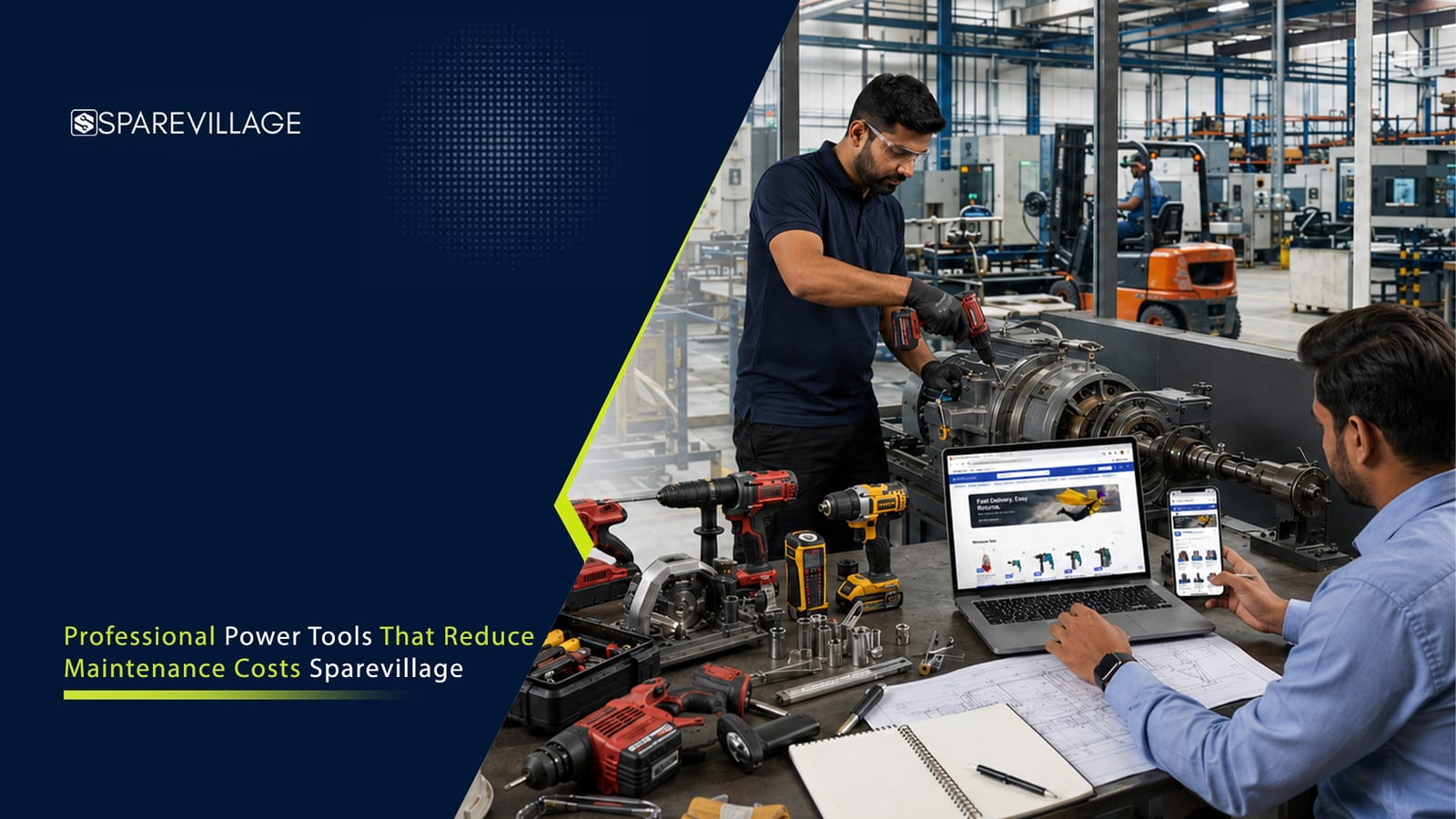
Professional Power Tools That Reduce Maintenance Costs | Sparevillage
Power tools that reduce maintenance costs for industrial buyers, brushless motors, sealed bodies, and real fleet data compared.
Article Content
Intro:
Every plant manager has lived this moment. A drill or grinder dies mid-shift, the line stops, and someone starts calling vendors while the whole floor waits. It looks like a small breakdown. It never is.
A recent industry survey found that unplanned downtime costs Indian industrial businesses close to ₹7 million for every hour of disruption, and 88% of Indian manufacturers face this kind of outage at least once a month. A tool that keeps failing isn't a minor inconvenience on a spreadsheet, it's a recurring hit to production, labor cost, and delivery timelines.
So the real question industry owners should be asking isn't "which power tool is cheapest to buy." It's "which power tool actually costs the least to keep running." This guide answers that question with facts, not marketing language, and points you toward tools that are built to survive daily industrial use.
Why Power Tool Maintenance Costs Are Quietly Draining Your Budget
Most factories track fuel, raw material, and labor costs closely. Tool maintenance rarely gets the same attention, even though it adds up fast: replacement brushes, worn gears, seized bearings, service call-outs, and the labor hours lost while a machine sits idle.
Unplanned equipment downtime remains one of the most underestimated costs on a factory floor. Nearly one in five Indian industrial firms still runs a "run-to-fail" maintenance approach, they wait for a tool to break instead of choosing equipment designed to resist failure in the first place. That approach feels cheaper on day one and costs far more over a year.
If your maintenance register shows the same tool going in for repair every few months, the problem usually isn't the operator. It's the motor and build inside the tool. If you're starting your research from scratch, our Industrial Buyer's Guide to Professional Power Tools is a good place to see how the fundamentals connect to this maintenance angle.
The Real Reason Your Tools Keep Breaking Down
Most maintenance-heavy power tools share one thing in common: a brushed motor. Inside a brushed motor, carbon brushes physically drag against a spinning commutator to conduct electricity. That constant friction wears the brushes down, and once they degrade, tool performance drops and the commutator itself can get damaged. Regular brush replacement becomes an unavoidable, recurring maintenance task.
This is not a design flaw, brushed motors are simply older technology, mechanically simpler, and cheaper to manufacture. That's exactly why they still dominate the lower end of the market. But for a workshop running tools eight to ten hours a day, that simplicity translates directly into more service visits and more downtime. This is exactly the kind of oversight covered in 7 Mistakes Buyers Make When Choosing Power Tools, if you want to see where else buyers commonly get caught out.
Brushless Motor Technology: The Single Biggest Cost-Cutter
If you want one upgrade that meaningfully reduces long-term maintenance spend, it's switching to brushless motor tools. There are no carbon brushes to wear down, no friction-related degradation, and no commutator to damage over time. Brushless motors also run cooler because the copper windings sit closer to the housing's air vents, which reduces heat-related wear on internal components.
An automotive fleet workshop that switched an air-powered impact wrench for a brushless cordless model found maintenance dropped from daily lubrication and parts replaced every six months, to basic cleaning and battery care with the tool running a full year without service disruption. That's not a marginal improvement. That's the difference between a tool that needs constant attention and one that simply works.
Brushless tools also adjust power draw electronically based on the resistance they sense, which means the motor isn't working harder than the task demands. Less strain on internal parts means fewer failures over the tool's working life.
The catch is the upfront price. Brushless tools cost more to buy than brushed equivalents, because the electronics and magnet components are more expensive to produce. For a factory buying in bulk or replacing tools every year, though, the lower failure rate and reduced service cost make brushless the better total investment, not just the more "premium" one. For a fuller walkthrough of how these trade-offs play out across categories, The Complete Buyer's Guide to Industrial Power Tools covers it in more depth.
Sealed and IP-Rated Bodies Cut Contamination-Related Failures
Dust, metal shavings, and moisture are the quiet killers of workshop power tools. A tool without a sealed housing lets fine particles into the motor and gear assembly, where they accelerate wear on bearings and internal components. This is especially common in welding units, fabrication shops, and construction sites where airborne dust is constant, and it's one of the simplest specs to check for anyone genuinely shopping for power tools that reduce maintenance costs.
Tools rated IP54 or higher have sealed switches and protected vents that keep contaminants out. If your unit works in a dusty or wet environment, this single spec often matters more than raw power output when it comes to service frequency. Skipping this check is one of the reasons Avoid These Mistakes When Buying Power Tools exists as a checklist worth reading before a bulk order goes out.
Corded vs Cordless: Which Actually Costs Less to Maintain
This is one of the most common questions procurement teams ask, and the honest answer is: it depends on duty cycle, not on which format looks more modern.
Corded tools with a heavy-duty motor can run continuously without battery swaps or charge cycles, which suits fixed workstations like drill presses or bench grinders. There's no battery to degrade over time, which removes one entire category of maintenance and replacement cost.
Cordless tools win on mobility and are increasingly the better choice for teams moving between job sites or work bays, especially now that motor efficiency has closed much of the old performance gap. The trade-off is battery life cycle: lithium-ion packs typically hold a useful charge for a few years of daily use before capacity drops enough to need replacement.
For a workshop that stays in one place and runs a tool for hours without a break, corded may genuinely be the lower-maintenance option. For teams that move between floors, vehicles, or sites, a well-built cordless platform with a reliable motor usually wins on total cost once you factor in the hours saved from not being tethered to a socket. If you're mapping out a full toolkit rather than a single purchase, the Essential Professional Power Tools List for Industrial Buyers is worth a look alongside this comparison.
Battery Platform Standardization Reduces Spare Costs
For cordless tool fleets, maintenance cost isn't only about the motor. It's also about how many different battery and charger systems your team is managing. Mixed-brand tool fleets often mean multiple incompatible battery platforms, which means more spare batteries sitting idle, more chargers to maintain, and more confusion on the floor about which battery fits which tool.
Standardizing on one battery platform across drills, grinders, and impact drivers cuts the number of spare parts a facility needs to stock, and it simplifies training for new operators. It's a smaller factor than motor type, but it adds up across a fleet of twenty or thirty tools.
Torque Control and Overload Protection Extend Tool Life
Industrial-grade power tools increasingly include electronic torque control and overload protection, which automatically cut power before internal components get pushed past their limit. Without this protection, a tool used slightly beyond its rated capacity, a common reality on busy floors, takes on stress that shortens gear and motor life over time.
This feature matters most for impact wrenches, angle grinders, and rotary hammers, which see the heaviest continuous load in industrial settings. A tool with overload protection may cost a little more, but it's designed to survive operator error, which is worth more than the price difference over a year of daily use. Our 12-Point Power Tools Buying Checklist for Professionals walks through this and similar specs in a format you can hand straight to your procurement team.
How to Calculate the Real Cost of a Power Tool (Not Just the Price Tag)
Purchase price is only one part of the equation. A more honest number is total cost of ownership, which factors in:
Purchase price of the tool
Expected service and part replacement cost over its working life
Average downtime hours caused by that tool category
Battery and charger compatibility across your existing fleet
Expected working life in hours, based on duty cycle
A tool priced 20% higher but rated for double the working hours, with a sealed body and low-friction motor design, is very often the cheaper choice once you run these numbers across a full year. Equipment failure remains the single largest cause of unplanned downtime in manufacturing, ahead of human error or supply issues, which is exactly why the tool you choose has more leverage over your maintenance budget than almost any other single decision on the floor.
Here's a simplified example. Say your workshop is comparing two impact wrenches for daily use across a 12-month period:
Lets See Example:
Once service visits and lost production hours are added in, the tool with the higher sticker price frequently ends up cheaper by the end of the first year, and the gap widens every year after that as the lower-maintenance tool keeps running with fewer interruptions. This is exactly why power tools that reduce maintenance costs deserve more weight in a purchase decision than the invoice total alone. Which Power Tools Actually Deliver Low Maintenance in Industrial Use Based on what workshops and fleet managers consistently report, a few tool categories show the clearest gap between brushed and brushless, low-maintenance versions: Cordless impact wrenches — heavily used in automotive and assembly work; brushless sealed models routinely outlast pneumatic and brushed equivalents by months. Angle grinders — high dust exposure makes sealed, brushless models a clear upgrade for fabrication and metalworking shops. Rotary hammer drills — constant vibration load benefits from overload protection and a sealed gear housing. Cordless drill drivers — the most-used tool on most floors, where battery platform standardization matters as much as motor type. Reciprocating saws — frequent stalling under load makes overload protection especially valuable here. Circular saws — blade binding under continuous cutting is a common cause of premature motor strain, so overload cut-off and a sealed trigger switch matter more here than raw wattage. None of these are exotic upgrades. They're specification checks any procurement manager can run against a supplier's data sheet before placing a bulk order, and they take a few minutes to verify against the questions above. Where to Source Verified, Genuine Power Tools in India None of these specifications matter if the tool arriving at your dock isn't genuine, or if the supplier disappears after the sale. Industrial buyers lose real money to grey-market tools with no warranty support and no traceable origin. SpareVillage works as a verified B2B marketplace connecting industrial buyers directly with checked suppliers across power tools, hand tools, and industrial equipment, so procurement teams aren't gambling on unverified sellers for equipment their production depends on. If you're building or refreshing a tool fleet, it's worth browsing the Power Tools collection to compare brushless and sealed models side by side before you commit a budget to a new batch of equipment. For teams also reviewing their broader sourcing strategy, the B2B Marketplace page is a reasonable place to see how tool procurement fits alongside other industrial categories on one verified platform. Conclusion The tools that cost the least to run are rarely the cheapest ones to buy. Brushless motors, sealed housings, standardized batteries, and overload protection all point in the same direction: fewer breakdowns, fewer service calls, and fewer hours lost to a stopped line. Before your next purchase order goes out, run the total cost of ownership number, not just the invoice price. It's the single habit that separates factories with a stable maintenance budget from the ones still firefighting every month. And once the right tools are on your floor, How to Maintain Power Tools Like a Professional Workshop is the natural next read to keep them running that way.
FAQs:
1. Why does SpareVillage recommend checking battery replacement cost before buying a cordless power tool?
Because a replacement battery often costs nearly as much as a new base tool. Buyers frequently discover this only after their original battery degrades within a year or two of daily use. Before purchase, check battery price separately, not just the tool's combo price, so you know the real ongoing cost of staying on that platform.
2. Is it true that brushless power tools break down more easily, as some buyers on forums claim?
No, this is a misunderstanding. Brushless motors are generally more durable, not more fragile. What breaks easily is the surrounding electronics on cheap, poorly built units. Choose a tool with proper thermal protection and a reputable build, and brushless will consistently outlast a brushed motor under daily industrial load.
3. Why does SpareVillage suggest checking duty cycle before choosing cordless over corded tools?
Because cordless tools lose runtime faster under continuous heavy use, which frustrates buyers expecting all-day performance. Corded tools don't face this limit since they draw power directly. If your job involves long, uninterrupted sessions, corded remains more reliable. Reserve cordless for mobility-first tasks, not marathon runs.
4. How can a buyer tell if a power tool is genuine and not a grey-market unit?
Check for a proper GST invoice, a traceable brand serial number, and warranty documentation from an authorized seller. Grey-market tools often lack all three, and buyers only discover this when a warranty claim gets rejected later. Always confirm these details with the supplier before payment, not after delivery.
5. Why do power tool warranty claims often get rejected, based on buyer complaints online?
Most rejections happen because the tool was bought from an unauthorized seller, or proper purchase documentation wasn't kept. Manufacturers require proof of authorized sale and correct usage within rated limits. Buying from a verified B2B marketplace with proper invoicing protects your claim rights from day one.
6. Which power tool brand actually lasts longest in daily industrial use, according to real buyers?
No single brand wins across every category consistently. Reliability depends more on the specific model, motor type, and how well it matches your duty cycle than on brand name alone. Focus on IP rating, motor type, and verified supplier reputation rather than chasing one particular brand.
7. Why do spare parts become hard to find for a power tool after a year or two?
This usually happens with unauthorized imports or discontinued models that lack a proper local distribution and service network. Before buying in bulk, confirm spare part and service availability with your supplier. A verified B2B marketplace typically maintains ongoing supplier relationships that make replacement parts easier to source later.
8. Is it cheaper to repair a failing power tool or replace it entirely?
If repair costs exceed 40-50% of a new tool's price, replacement is usually the smarter move. Frequent repairs also signal a deeper design or build issue that will likely recur. Track your repair history per tool; repeated failures are a stronger signal than any single repair bill.
9. Why does a power tool that worked fine for months suddenly overheat or burn out?
This is often caused by continuous use beyond the tool's rated duty cycle, poor ventilation, or dust buildup inside the motor housing. Overheating rarely happens overnight; it builds up from unnoticed strain. Regular cleaning and matching the tool's rated capacity to your actual workload prevents most sudden burnouts.
10. How can factories get proper GST invoices when ordering power tools in bulk?
Order only through registered, GST-compliant suppliers who issue proper tax invoices with GSTIN details for every purchase. This is a common pain point for procurement teams buying from unverified sellers. A verified B2B marketplace typically handles this documentation automatically, which matters for both compliance and warranty validity.
11. What makes a power tool "low maintenance" in an industrial setting?
A low-maintenance power tool typically uses a brushless motor, a sealed or IP-rated housing, and overload protection. Together these reduce internal wear, keep out dust and moisture, and prevent damage from accidental overload during daily use.
12. Are brushless power tools really worth the higher price?
For daily industrial use, yes. Brushless motors have no brushes to wear out, run cooler, and typically last significantly longer between failures than brushed equivalents, which usually offsets the higher purchase cost within the first year or two of heavy use.
13. How much does unplanned tool downtime actually cost a factory?
Indian industrial businesses report unplanned downtime costs of nearly ₹7 million per hour of disruption on average, according to a recent global maintenance survey, making equipment reliability a direct financial priority rather than a minor operational detail.
14. What is total cost of ownership for a power tool?
It's the combined cost of the purchase price, expected servicing, downtime caused by failures, and battery or spare part compatibility over the tool's working life, rather than just the sticker price at checkout.
15. Do sealed power tools really perform better in dusty environments?
Yes. Sealed switches and protected vents keep metal dust and debris out of the motor and gear assembly, which is one of the most common causes of premature wear in welding, grinding, and fabrication work.
16. Should a small workshop invest in brushless tools or stick with brushed ones?
For occasional or light use, brushed tools can still make sense due to lower upfront cost. For daily, multi-hour industrial use, brushless tools generally reduce total spend over time despite the higher initial price.
17. Why do impact wrenches need overload protection?
Impact wrenches regularly face loads at or beyond their rated capacity in daily industrial use. Overload protection cuts power before this stress damages the gear train or motor, extending the tool's working life.
18. Does battery platform standardization actually reduce costs?
It reduces the number of spare batteries and chargers a facility needs to stock, simplifies operator training, and avoids downtime caused by battery-tool mismatches across a mixed fleet.
19. What's the most common cause of power tool failure in factories?
Equipment failure, including motor burnout and bearing wear, is consistently the leading cause of unplanned downtime across manufacturing sectors, ahead of human error, material issues, or supply disruptions.
20. Are corded power tools cheaper to maintain than cordless ones?
Corded brushed tools have a simpler design and lower upfront cost, but cordless brushless tools generally need less frequent part replacement. The right choice depends on your duty cycle and how much mobility your team needs.