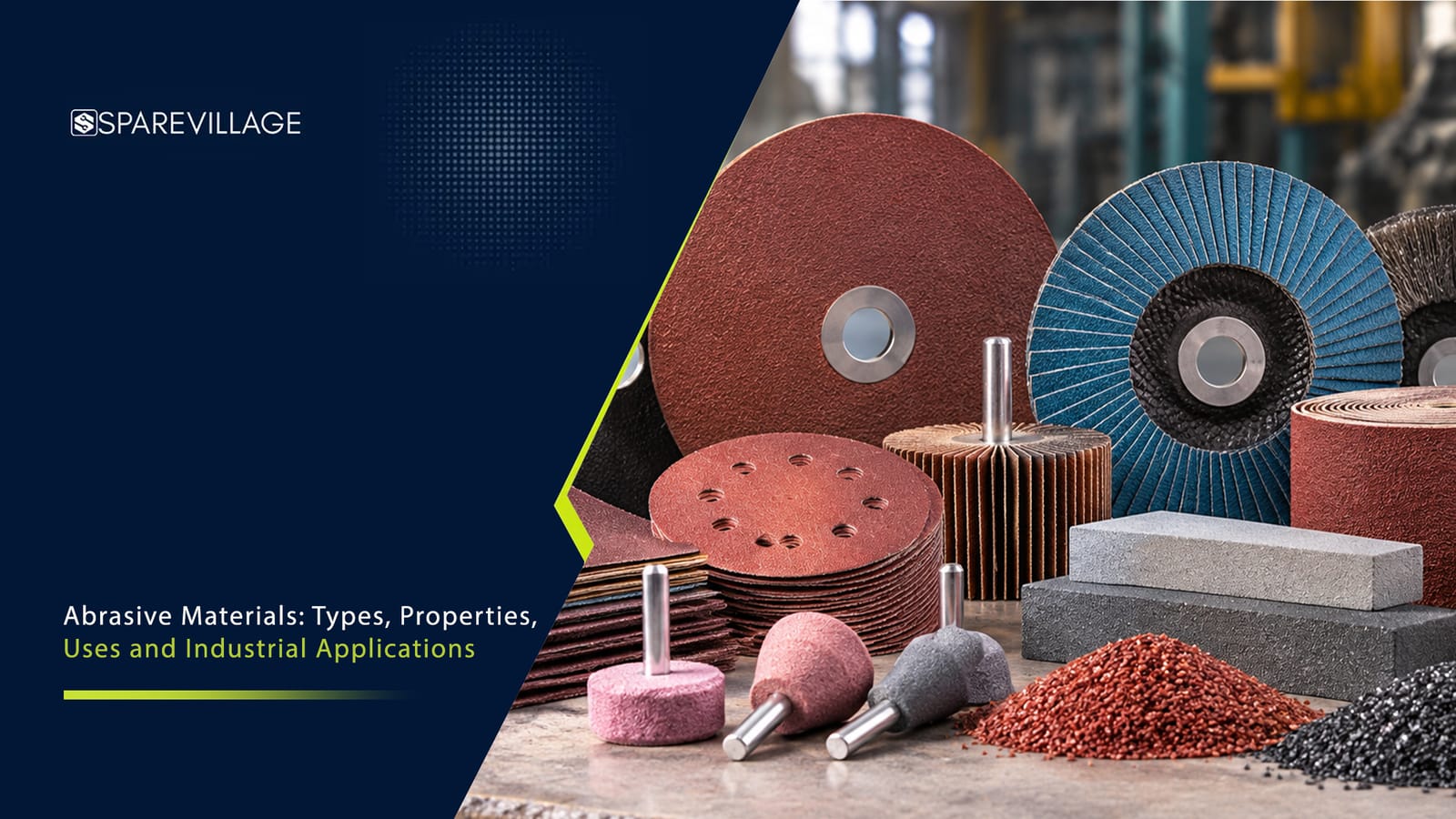
Abrasive Materials: Types, Properties, Uses and Industrial Applications
Abrasive materials: Explore their types, properties, uses and industrial applications. Learn how to choose the right abrasives for grinding and finishing.
Article Content
Intro:
Abrasive materials play an important role in manufacturing, metal fabrication, construction, automotive production and industrial maintenance. They help remove unwanted material, smooth rough surfaces, sharpen tools, cut hard materials and achieve the required surface finish.
Different industrial operations require different abrasive materials. A grinding operation on stainless steel, for example, may need a different abrasive grain than polishing glass or finishing an aluminium component. Choosing the wrong abrasive can affect the surface quality, working time, product life and overall operating cost.
Understanding the types of abrasive materials, their properties and applications helps businesses select the right products for their work requirements.
This guide explains natural and synthetic abrasives, abrasive grains, bonded and coated abrasives, their industrial applications and the important factors to consider before purchasing industrial abrasives.
What Are Abrasive Materials?
Abrasive materials are hard substances used to remove unwanted material from the surface of another material through friction and controlled cutting action.
They contain small, hard particles called abrasive grains. When these grains come into contact with a workpiece, their sharp edges remove small amounts of material. This process helps cut, grind, smooth, clean or polish different surfaces.
Abrasive materials are commonly used on metals, wood, glass, ceramics, concrete and stone.
For example:
In metal fabrication, abrasives remove burrs, weld marks and rough edges.
In automotive workshops, they help prepare vehicle surfaces before painting.
In woodworking, they smooth wooden surfaces and remove uneven areas.
In construction, they help cut concrete, stone and other hard materials.
In manufacturing, they support precision grinding and surface finishing.
The performance of an abrasive depends on its hardness, grain size, toughness, shape and compatibility with the workpiece.
Unlike ordinary cleaning materials, abrasives are designed to remove material through mechanical action. The amount removed depends on the abrasive type, applied pressure, movement and operating conditions.
How Do Abrasive Materials Work?
Abrasive materials work through a process called abrasion. Their hard grains come into contact with a workpiece and remove small particles from its surface.
Each abrasive grain acts like a tiny cutting edge. When the abrasive moves across the workpiece, these edges cut, scratch or wear away unwanted material.
The working process generally involves three important factors.
1. Abrasive Grain and Material Removal
Abrasive grains are responsible for the actual cutting and grinding action.
When pressure is applied, the sharp edges of these grains interact with the workpiece. They remove small chips or particles from the surface.
The amount of material removed depends on:
Hardness of the abrasive grain.
Sharpness and shape of the grain.
Size of the abrasive particles.
Pressure applied during operation.
Speed of the machine.
Coarse and sharp grains generally support faster material removal, while finer grains are used when a smoother surface is required.
2. Friction and Surface Finishing
Friction is created when abrasive grains move against a workpiece.
This interaction removes unwanted material and changes the surface texture. Depending on the abrasive and application, the result can range from a rough ground surface to a fine polished finish.
However, friction also generates heat. Excessive heat can damage the workpiece, affect its surface properties or cause discolouration.
For this reason, selecting the correct abrasive and operating conditions is important, especially during precision grinding and metal finishing.
3. Factors That Affect Abrasive Performance
The performance of abrasive materials depends on several factors.
Hardness: Determines the ability of abrasive grains to cut into the workpiece.
Grain shape: Sharp and angular grains generally provide stronger cutting action.
Grain size: Controls the level of material removal and surface finish.
Toughness: Helps grains withstand working pressure without breaking too early.
Friability: Determines how grains fracture and expose new cutting edges.
Operating speed: Affects cutting performance and heat generation.
Applied pressure: Influences the contact between the abrasive and workpiece.
Understanding these factors makes it easier to select abrasives for different industrial operations.
What Are the Different Types of Abrasive Materials?
Abrasive materials are broadly classified into natural and synthetic abrasives based on their origin.
Both types are used in industrial applications. However, their properties, manufacturing processes and suitability can differ.
1. Natural Abrasive Materials
Natural abrasives are obtained from naturally occurring minerals. They are processed into grains or particles and used in different grinding, sanding, blasting and polishing applications.
Some commonly known natural abrasive materials include:
Diamond
Natural diamond is one of the hardest naturally occurring materials. Its high hardness and wear resistance make it suitable for demanding cutting and precision applications.
It is used in specialised cutting tools, grinding applications and polishing operations involving hard materials.
Garnet
Garnet is a naturally occurring mineral used as an abrasive grain.
It is commonly used in abrasive blasting, surface preparation and certain sanding applications. Its hardness and grain characteristics make it useful for removing coatings, rust and surface contaminants.
Emery
Emery is a naturally occurring abrasive material mainly composed of corundum and other minerals.
It is used in metal finishing, surface preparation and abrasive products such as emery cloth. It is suitable for general-purpose sanding and cleaning applications.
Quartz and Flint
Quartz and flint are silica-based materials with abrasive properties.
They have been used in traditional sanding and abrasive applications. However, dust containing respirable crystalline silica can cause serious health problems when inhaled.
Modern industrial operations must consider safer alternatives and suitable dust-control measures when selecting abrasive materials.
2. Synthetic Abrasive Materials
Synthetic abrasives are manufactured under controlled conditions to achieve specific hardness, grain structure and performance characteristics.
They are widely used in modern industrial grinding, cutting and finishing operations.
Some important synthetic abrasive materials include:
Aluminium Oxide (Aluminium Oxide Abrasive)
Aluminium oxide is one of the most widely used abrasive grains in industrial applications.
It offers a useful balance of hardness, toughness and durability. It is commonly used for grinding and sanding steel, carbon steel, alloy steel and other suitable materials.
Common applications include:
Metal grinding and deburring.
Grinding wheel manufacturing.
Sanding discs and abrasive belts.
Wood surface preparation.
General metal finishing.
It is a practical choice for many general-purpose industrial grinding operations.
Silicon Carbide
Silicon carbide is a hard abrasive material with sharp cutting edges. It is generally more brittle than aluminium oxide, which allows the grains to break and expose new sharp edges.
It is commonly used for grinding and finishing glass, ceramics, stone, cast iron and non-ferrous metals.
Typical applications include:
Glass and ceramic finishing.
Aluminium surface preparation.
Wet and dry sanding.
Stone grinding.
Fine surface finishing.
Zirconia Alumina
Zirconia alumina is a tough synthetic abrasive grain designed for demanding grinding applications.
It can withstand higher working pressure and is commonly used where consistent material removal and abrasive life are important.
Its applications include:
Heavy-duty metal grinding.
Stainless steel fabrication.
Weld removal.
Grinding abrasive belts.
Industrial surface preparation.
Ceramic Abrasives
Ceramic abrasives are engineered abrasive grains with a fine microcrystalline structure.
They are designed to maintain cutting performance through controlled grain breakdown. This helps expose fresh cutting edges during use.
They are commonly used for demanding grinding operations involving stainless steel, hardened steel and certain difficult-to-grind alloys.
Cubic Boron Nitride (CBN)
Cubic boron nitride is a superabrasive material known for its high hardness and thermal stability.
It is particularly suitable for precision grinding of hardened steels and other suitable ferrous materials.
Its applications include tool manufacturing, precision machining and specialised industrial grinding.
Synthetic Diamond
Synthetic diamond is manufactured for industrial applications where high hardness and wear resistance are required.
It is used in cutting, grinding and polishing tools for hard and abrasive materials such as ceramics, glass, carbide and stone.
The selection between natural and synthetic diamond depends on the tool design, application and required performance.
Classification of Abrasive Products Based on Their Structure
Abrasive materials are also classified according to how abrasive grains are held together or applied to a surface.
The main types include bonded, coated, loose and non-woven abrasives.
1. Bonded Abrasives
Bonded abrasives are manufactured by combining abrasive grains with bonding materials. The bonding agent holds the grains together and gives the finished product its shape and strength.
The type of bond affects how the abrasive performs during cutting and grinding.
Common bonding materials include resin, vitrified bonds, rubber and other specialised bonding agents.
Examples include:
Grinding wheels.
Cutting wheels.
Abrasive mounted points.
Abrasive stones.
Industrial applications: Bonded abrasives are used for metal cutting, surface grinding, tool sharpening, weld removal and precision finishing.
For different workshop requirements, buyers can explore Grinding Wheels, Cutoff & Chopsaw Wheels and Abrasive Mounted Points.
2. Coated Abrasives
Coated abrasives consist of abrasive grains attached to a backing material using an adhesive or bonding agent.
The backing can be made from paper, cloth, polyester film or fibre.
The abrasive grains are distributed across the backing to provide a working surface for sanding, grinding and finishing.
Common examples include:
Sandpaper.
Abrasive belts.
Sanding discs.
Emery cloth.
Abrasive sheets.
Industrial applications: Coated abrasives are used for wood sanding, metal surface preparation, paint removal, deburring and finishing.
They are available in different grain sizes to suit both rough material removal and fine finishing.
Explore Sanding Discs, Belts & Papers and Flap Discs for different sanding and surface-finishing requirements.
3. Loose Abrasives
Loose abrasives are abrasive grains or powders that are not fixed into a wheel or backing material.
They are applied directly or mixed with a suitable liquid, paste or compound, depending on the process.
Examples include:
Abrasive powders.
Polishing compounds.
Lapping materials.
Abrasive blasting media.
Industrial applications: Loose abrasives are used for precision polishing, lapping, surface cleaning and finishing operations.
They are useful when controlled surface removal or a fine finish is required.
For these applications, businesses can explore Abrasive Powders & Pastes.
4. Non-Woven Abrasives
Non-woven abrasives are made by distributing abrasive grains throughout a flexible fibrous structure.
The open structure allows them to work on different surface shapes and contours.
They are commonly used for:
Surface cleaning.
Light deburring.
Removing surface marks.
Blending metal finishes.
Preparing surfaces before coating.
These abrasives are useful when the objective is to improve surface appearance without removing excessive material.
Important Properties of Abrasive Materials
Understanding the properties of abrasive materials helps industrial buyers select products according to the workpiece and required finish.
1. Hardness
Hardness is the ability of a material to resist scratching or penetration.
Abrasive grains generally need to be sufficiently hard to cut the workpiece effectively.
For example, silicon carbide is suitable for many hard and brittle materials, while aluminium oxide is widely used for general metal grinding.
2. Toughness
Toughness is the ability of abrasive grains to withstand force without breaking too easily.
It is important in heavy-duty grinding applications where the abrasive faces continuous pressure.
Zirconia alumina is commonly selected for demanding grinding operations because of its toughness.
3. Friability
Friability describes how easily abrasive grains break under pressure.
Some grains fracture during grinding and expose fresh cutting edges. This helps maintain cutting performance.
However, excessive grain breakdown can reduce abrasive life. The correct balance depends on the application.
4. Grain Size and Grit
Grit size refers to the size classification of abrasive particles.
It directly affects the amount of material removed and the final surface finish.
Coarse grit: Used for aggressive material removal, heavy grinding and rough surface preparation.
Medium grit: Used for general grinding, deburring and intermediate finishing.
Fine grit: Used for smoother surface preparation and finishing.
Very fine grit: Used for precision finishing and polishing applications.
The actual particle size represented by a grit number depends on the grading system used. Therefore, buyers should check whether the product follows FEPA, ANSI or another specified standard.
5. Thermal Stability
Thermal stability refers to the ability of abrasive materials to maintain their properties under operating heat.
Grinding operations can generate significant heat due to friction. An abrasive with suitable thermal properties helps maintain performance under the intended working conditions.
This is especially important in high-speed and precision grinding applications.
6. Chemical and Material Compatibility
An abrasive must be suitable for the material being processed.
Some abrasive grains are better suited to ferrous metals, while others are commonly used on non-ferrous metals, glass, ceramics and stone.
Compatibility also depends on operating temperature, moisture, coolant and the required surface finish.
Industrial Applications of Abrasive Materials
Abrasive materials are used across several industries. Their role changes according to the type of work, material and required surface quality.
1. Metal Fabrication and Engineering
Metal fabrication units use abrasives for cutting, grinding, deburring and surface preparation.
Common applications include:
Removing excess weld material.
Grinding metal edges.
Cleaning welded joints.
Removing burrs from fabricated components.
Preparing metal surfaces before painting.
Finishing steel and stainless steel components.
Grinding wheels, cutting wheels and flap discs are commonly used for these operations.
2. Automotive Industry
Automotive manufacturing and repair involve several surface-finishing processes.
Abrasives help prepare metal components, body panels and other vehicle parts.
Common applications include:
Removing old paint and coatings.
Smoothing vehicle body panels.
Grinding metal components.
Preparing surfaces before painting.
Polishing metal parts.
Finishing manufactured components.
The correct abrasive grain and grit size help achieve the required surface finish without damaging the workpiece.
3. Construction and Infrastructure
Construction projects use abrasives for cutting, grinding and finishing hard materials.
They are commonly used in:
Concrete surface grinding.
Stone cutting and shaping.
Tile and masonry finishing.
Removing uneven surface areas.
Preparing floors before applying coatings.
Cutting hard construction materials.
Diamond abrasives are widely used in specialised cutting and grinding tools for concrete, stone and other hard materials.
4. Woodworking and Furniture Manufacturing
Woodworking operations require different abrasive grades depending on the stage of finishing.
Abrasives help remove rough surfaces, smooth edges and prepare wooden products for coatings.
Common applications include:
Sanding wooden boards.
Smoothing furniture surfaces.
Removing rough edges.
Preparing wood before painting.
Finishing wooden doors and panels.
Aluminium oxide abrasives are commonly used in woodworking sandpapers and sanding belts.
5. Glass and Ceramic Manufacturing
Glass and ceramic products often require controlled edge finishing and surface treatment.
Abrasive materials help remove sharp edges, smooth surfaces and achieve the required dimensions.
Common applications include:
Glass edge grinding.
Ceramic surface finishing.
Removing rough edges.
Precision grinding.
Polishing glass surfaces.
Silicon carbide and diamond abrasives are used in suitable glass and ceramic processing applications.
6. Aerospace and Heavy Engineering
Aerospace and heavy engineering operations often require controlled material removal and accurate surface finishing.
Abrasives are used for:
Precision grinding of components.
Finishing specialised alloys.
Preparing machined surfaces.
Removing minor surface irregularities.
Tool and component finishing.
The abrasive must match the workpiece material and the required dimensional and surface tolerances.
Common Abrasive Products and Their Uses
Abrasive grains are available in different product forms. Each product is designed for particular machines and industrial operations.
Difference Between Grinding, Sanding, Cutting and Polishing
These operations use abrasive materials but serve different purposes.
Grinding: Removes material from a workpiece to change its shape, remove excess material or improve its surface.
Sanding: Smooths a surface by removing small irregularities, old coatings or rough areas.
Cutting: Separates a material into required sections using a suitable abrasive cutting wheel or tool.
Polishing: Improves surface appearance and smoothness by removing very fine surface irregularities.
Selecting the correct abrasive product for each operation helps achieve better working results.
How to Choose the Right Abrasive Material for Your Application
Selecting the right abrasive material requires more than checking its price or grain type. Buyers should consider the workpiece, machine, operation and expected finish.
1. Identify the Workpiece Material
Start by identifying the material you need to process.
Different materials require different abrasive characteristics.
These are general starting points. The exact selection depends on the material grade, abrasive product construction and working conditions.
2. Determine the Required Surface Finish
The final surface quality plays an important role in abrasive selection.
If the objective is to remove excess material or heavy weld marks, a suitable coarse abrasive may be required.
For general surface preparation, medium grit may be more appropriate.
For fine finishing and polishing, finer abrasive grades are generally preferred.
Always consider the required finish before selecting the grit size.
3. Consider Material Removal Requirements
Understand how much material needs to be removed.
Heavy material removal requires an abrasive product designed for more aggressive cutting action.
General grinding requires a balance between cutting performance and product life.
Fine finishing requires controlled material removal to avoid unnecessary surface damage.
Choosing the correct product for the operation helps maintain consistent results.
4. Select the Correct Abrasive Grain
The abrasive grain should match the workpiece and grinding conditions.
For example:
Aluminium oxide is widely used for general metal grinding.
Silicon carbide is suitable for many non-ferrous and brittle materials.
Zirconia alumina is used for demanding metal grinding.
Ceramic abrasives are used in high-performance grinding applications.
CBN is suitable for specialised grinding of hardened steels.
Diamond is used for hard and abrasive materials such as ceramics, stone and carbide.
Do not select a grain only because it is harder. Toughness, friability, heat generation and compatibility also matter.
5. Check Machine Compatibility
Abrasive products must be compatible with the machine on which they will be used.
Before purchasing, check:
Machine type and application.
Abrasive wheel or disc diameter.
Bore or mounting size.
Product thickness.
Maximum rated RPM.
Machine operating speed.
Manufacturer's mounting and operating instructions.
Never use a grinding wheel or disc if its specifications are not suitable for the machine.
6. Consider Product Life and Overall Cost
The cheapest abrasive product is not always the most economical option.
A product with a lower purchase price may require frequent replacement or deliver inconsistent finishing results.
Industrial buyers should consider:
Material removal performance.
Product life.
Consistency of finish.
Replacement frequency.
Machine compatibility.
Total operating cost.
This approach helps businesses make better purchasing decisions.
Difference Between Natural and Synthetic Abrasive Materials
Natural and synthetic abrasives differ mainly in their source, composition and manufacturing process.
Natural abrasives are useful in several traditional and specialised applications.
Synthetic abrasives are widely used in modern manufacturing because their grain properties and particle sizes can be controlled to meet specific industrial requirements.
The right choice depends on the operation rather than whether the abrasive is natural or synthetic.
How Are Abrasive Materials Manufactured?
The manufacturing process depends on the abrasive grain and the final product.
Synthetic abrasive grains generally undergo controlled production processes to achieve the required composition and characteristics.
The main stages can include:
1. Raw Material Selection: Suitable raw materials are selected according to the abrasive grain being manufactured.
2. Processing: Raw materials undergo suitable processing, which may involve crushing, melting or chemical and thermal treatment.
3. Grain Sizing: The processed material is separated into different particle sizes according to the required grading system.
4. Grain Treatment: Some abrasive grains receive additional treatments to improve their performance in specific applications.
5. Bonding or Coating: For finished abrasive products, grains are combined with bonding agents or attached to backing materials.
6. Product Shaping and Curing: Bonded abrasive products are shaped and processed to develop the required strength and structure. Coated products undergo suitable bonding and curing processes.
7. Quality Inspection: Finished products are checked for relevant dimensions, specifications and performance requirements.
Not every abrasive follows the same manufacturing process. Loose abrasive grains, bonded wheels and coated abrasive products have different production requirements.
What Is the Difference Between Abrasive Materials and Abrasive Tools?
Abrasive materials and abrasive tools are related, but they are not the same.
Abrasive materials are the grains or particles that perform the actual cutting, grinding and polishing action.
Abrasive tools are finished products that use these materials to perform a particular operation.
For example, aluminium oxide is an abrasive material. When these grains are combined with a bonding agent and formed into a wheel, the finished product becomes a grinding wheel.
Similarly, abrasive grains attached to a paper or cloth backing form products such as sandpaper and abrasive belts.
Understanding this difference helps buyers identify whether they need raw abrasive grains, polishing compounds or ready-to-use abrasive products.
Safety Precautions When Working With Abrasive Materials
Abrasive operations can generate dust, sparks, heat and flying particles. Incorrectly used grinding wheels and cutting discs can also create serious safety risks.
Follow these precautions during industrial operations:
Wear suitable safety glasses and face protection.
Use appropriate respiratory protection where dust is generated.
Ensure proper ventilation and dust extraction.
Inspect grinding wheels and discs before installation.
Check the product for cracks, damage or other visible defects.
Never exceed the maximum operating speed marked on the abrasive product.
Use the correct machine guard.
Ensure the wheel fits the machine and mounting system correctly.
Follow the manufacturer's instructions for installation and operation.
Secure the workpiece before starting the operation.
Pay particular attention when working with concrete, stone and other materials that may generate respirable crystalline silica dust. Use suitable dust-control measures and follow applicable workplace safety requirements.
Common Mistakes to Avoid When Selecting Abrasive Materials
Choosing an unsuitable abrasive can affect finishing quality, product life and workplace safety.
Here are some common mistakes industrial buyers and operators should avoid.
1. Choosing the Wrong Abrasive Grain
Not every abrasive grain is suitable for every workpiece. Always check material compatibility before purchasing.
2. Using an Unsuitable Grit Size
Coarse grit may leave deeper surface marks, while very fine grit may not remove material efficiently during heavy grinding.
3. Ignoring Workpiece Compatibility
An abrasive designed for one material may not perform properly on another. Consider the material grade and application.
4. Selecting an Incompatible Grinding Wheel
Wheel dimensions, mounting requirements and maximum operating speed must match the machine specifications.
5. Overlooking Operating Conditions
Machine speed, applied pressure, heat generation and working environment can affect abrasive performance.
6. Ignoring Safety and Product Specifications
Never purchase or use abrasive products without checking their specifications, application suitability and safety instructions.
Factors to Consider Before Purchasing Industrial Abrasives
Before placing an order, industrial buyers should check the following details:
Type of abrasive grain.
Required grit size.
Intended grinding, cutting or polishing operation.
Workpiece material.
Product dimensions and specifications.
Machine and mounting compatibility.
Maximum operating speed.
Expected product life.
Manufacturer details and applicable safety standards.
Quantity required for regular operations.
For businesses with regular grinding, cutting and finishing requirements, maintaining the right range of abrasive products can also help avoid unnecessary procurement delays.
Conclusion: Choose the Right Abrasive Material for Better Industrial Finishing
Abrasive materials are essential for cutting, grinding, sanding, polishing and surface preparation across industrial applications. Aluminium oxide, silicon carbide, zirconia alumina, ceramic abrasives, CBN and diamond each have different properties and uses.
The right selection depends on the workpiece material, required surface finish, material removal requirements, machine compatibility and operating conditions.
Understanding these factors helps businesses choose suitable abrasive products, maintain finishing quality and manage operating costs.
At SpareVillage, businesses can explore a range of industrial abrasive products for different workshop, manufacturing and maintenance requirements. From Grinding Wheels and Cutoff & Chopsaw Wheels to Flap Discs, Buffing & Polishing Wheels and other finishing supplies, buyers can explore products suited to their applications.
Explore the complete Abrasives Collection on SpareVillage to find suitable abrasive products for your industrial requirements.
FAQs :
1. What are abrasive materials used for?
Abrasive materials are used for cutting, grinding, sanding, polishing and finishing different surfaces. They remove unwanted material through friction and controlled cutting action. Industries use them to remove burrs, clean weld joints, smooth metal surfaces, sharpen tools and prepare materials before painting or coating.
2. What are the main types of abrasive materials?
Abrasive materials are mainly classified into natural and synthetic abrasives. Natural abrasives include garnet, emery and natural diamond.
Synthetic abrasives include aluminium oxide, silicon carbide, zirconia alumina, ceramic abrasives, CBN and synthetic diamond. Based on product construction, abrasives are also classified as bonded, coated, loose and non-woven abrasives.
3. What is the difference between natural and synthetic abrasives?
Natural abrasives are obtained from naturally occurring minerals, while synthetic abrasives are manufactured under controlled conditions. Natural abrasive properties depend on their mineral composition and source. Synthetic abrasives can be engineered to achieve specific grain sizes, hardness and performance characteristics. Synthetic abrasives are widely used in modern industrial grinding and finishing applications.
4. Which abrasive material is best for metal grinding?
Aluminium oxide is a common choice for general-purpose metal grinding. Zirconia alumina and ceramic abrasives are used for demanding grinding operations, including suitable stainless steel applications. The right abrasive depends on the metal type, grinding pressure, required material removal and surface finish. Always check the product manufacturer's application recommendations.
5. What is the difference between aluminium oxide and silicon carbide abrasives?
Aluminium oxide is a tough abrasive commonly used for grinding steel, carbon steel and other suitable materials. Silicon carbide is harder and has sharp cutting edges, making it suitable for glass, ceramics, stone and many non-ferrous materials. The main difference is their application suitability and grain behaviour. Aluminium oxide is widely used for general metalworking, while silicon carbide is commonly selected for hard, brittle and non-ferrous materials.
6. What are abrasive grains?
Abrasive grains are small, hard particles responsible for cutting, grinding and polishing action. Their sharp edges remove small amounts of material when they come into contact with a workpiece. Common abrasive grains include aluminium oxide, silicon carbide, zirconia alumina, ceramic, diamond and cubic boron nitride. Their size, hardness, shape and toughness affect the performance of the finished abrasive product.
7. What is the difference between bonded and coated abrasives?
Bonded abrasives contain grains held together by a bonding material to form a solid product, such as a grinding wheel or cutting wheel. Coated abrasives have grains attached to a backing material such as paper, cloth or polyester. Sandpaper, sanding discs and abrasive belts are common examples. Bonded abrasives are commonly used for cutting and grinding, while coated abrasives are widely used for sanding and surface preparation.
8. What is the difference between grinding wheels and cutting wheels?
Grinding wheels are designed to remove material from a surface, smooth edges, remove weld marks and perform grinding operations. Cutting wheels are designed to separate materials into smaller sections. They are generally thinner than grinding wheels and are not intended for side grinding unless specifically designed for that purpose. Using the correct wheel for the intended operation is important for both performance and safety.
9. What does grit size mean in abrasive materials?
Grit size indicates the size classification of abrasive particles used in an abrasive product. It affects the surface finish and material removal rate. Coarse grit is generally used for heavy material removal, while medium grit is suitable for general grinding and fine grit is used for smoother finishing. A higher grit number generally indicates finer abrasive particles within the same grading system. Always check the applicable grit standard and manufacturer's specifications.
10. Which abrasive grit should I use for metal polishing?
The correct grit depends on the existing surface condition and the required finish. Coarser grades may be needed to remove deep scratches, rust or surface irregularities. Medium grades help reduce the marks left by earlier operations. Fine and very fine abrasives are used for smoother finishing and polishing. For best results, move through suitable grit stages instead of jumping directly from a very coarse abrasive to a very fine one.
11. What are the best abrasive materials for stainless steel?
Zirconia alumina, ceramic abrasives and suitable aluminium oxide products are commonly used for stainless steel grinding and finishing. The abrasive should be specifically recommended for stainless steel. Products intended for stainless steel should also be protected from contamination by particles from ordinary carbon steel, as such contamination can contribute to surface rust.
12. Which abrasive material is suitable for aluminium?
Silicon carbide and suitable aluminium oxide abrasives can be used for aluminium processing, depending on the operation and product design. Aluminium is relatively soft and can clog abrasive surfaces during grinding or sanding. Therefore, buyers should select products designed for non-ferrous metals. Suitable anti-loading coatings or product constructions can help reduce clogging.
13. What are industrial abrasives used in manufacturing?
Industrial abrasives are used for material removal, surface preparation and finishing during manufacturing.
Common applications include:
Grinding metal components.
Cutting steel sections and pipes.
Removing burrs from manufactured parts.
Cleaning welded joints.
Sanding wooden components.
Finishing glass and ceramic products.
Preparing surfaces before painting or coating.
The abrasive product depends on the workpiece, machine and required finish.
14. What is the difference between abrasive materials and polishing compounds?
Abrasive materials are hard grains or particles that remove material through mechanical action. They are available in different forms, including grinding wheels, sanding discs and abrasive powders. Polishing compounds are formulated products that contain fine abrasive particles along with other ingredients. They are used to improve surface smoothness and appearance. The choice depends on the required polishing process and the material being treated.
15. What are abrasive mounted points used for?
Abrasive mounted points are small abrasive tools attached to a mounting shank. They are used with compatible rotary machines for precision grinding and finishing. They are useful for working on small areas, internal surfaces, corners, edges and complex shapes where larger grinding wheels may not reach easily. They are commonly used in metal fabrication, tool rooms, engineering workshops and maintenance operations.
16. What is the purpose of dressing tools in grinding?
Dressing tools are used to restore the working surface and cutting condition of grinding wheels. During grinding, wheel surfaces can become loaded with workpiece material or lose their effective cutting profile. Dressing removes unwanted material from the wheel surface and exposes fresh abrasive grains. This helps maintain the wheel's cutting action and achieve a more consistent grinding result. Dressing is different from truing, which restores the wheel's required geometric shape and concentricity.
17. How do I choose between a flap disc and a grinding wheel?
A grinding wheel is generally selected for heavier material removal, stock removal and specific grinding operations. A flap disc consists of overlapping abrasive flaps arranged around a backing plate. It is commonly used for grinding, blending, deburring and surface finishing. For heavy-duty grinding, a suitable grinding wheel may be more appropriate. For combining material removal with a smoother finish, a flap disc may be a practical choice.
18. How long do abrasive grinding wheels last?
The life of an abrasive grinding wheel depends on its abrasive grain, bond type, wheel quality, workpiece material, operating speed and applied pressure. A wheel used for heavy material removal may wear faster than one used for lighter finishing operations. Incorrect machine speed, excessive pressure and unsuitable workpiece materials can also reduce its life. Buyers should consider cutting performance and usable product life rather than comparing only the initial purchase price.
19. What safety precautions should be followed when using abrasive materials?
Always follow the manufacturer's safety instructions and use the correct protective equipment.
Important precautions include:
Wear suitable safety glasses and face protection.
Use appropriate respiratory protection when dust is generated.
Check wheels and discs for cracks or damage.
Never exceed the maximum rated RPM.
Ensure correct mounting and machine compatibility.
Use machine guards during grinding and cutting.
Maintain proper ventilation and dust extraction.
Secure the workpiece before starting the machine.
These precautions help reduce the risk of injuries caused by flying particles, dust, sparks and damaged abrasive products.
20. Where can I buy industrial abrasive materials online in India?
Businesses can explore industrial abrasive products through SpareVillage, an online B2B marketplace serving businesses across India. Buyers can explore different abrasive categories, including grinding wheels, cutoff and chopsaw wheels, flap discs, buffing and polishing wheels, abrasive mounted points, dressing tools, abrasive powders and sanding discs. Before purchasing, check the product specifications, abrasive grain, grit size, dimensions and machine compatibility to ensure the product suits your application. Explore the SpareVillage Abrasives Collection to find abrasive products for industrial grinding, cutting and finishing requirements.